



Introduction
As data centers evolve toward higher density, cloud computing, and AI-driven workloads, the choice of UPS battery technology has become a critical infrastructure decision. The debate between lithium battery UPS and lead acid UPS systems is no longer just about upfront cost—it now involves lifecycle performance, efficiency, scalability, and long-term operational risk.
This guide provides a comprehensive comparison to help data center operators, engineers, and procurement teams determine which UPS battery technology is best suited for modern applications.
What Is a Lithium Battery UPS?
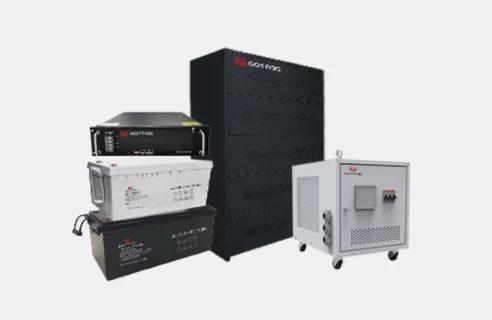
A lithium battery UPS system typically uses lithium iron phosphate (LiFePO4) or similar chemistries to deliver backup power. These systems integrate an advanced Battery Management System (BMS), which continuously monitors voltage, temperature, and charge cycles to ensure safety and optimal performance.
Lithium UPS solutions are designed for high-efficiency, high-density environments where space, reliability, and long-term cost control are priorities.
What Is a Lead Acid UPS?
Lead acid UPS systems, particularly VRLA (Valve-Regulated Lead-Acid) batteries, have been the traditional choice for backup power in data centers. They are widely used due to their lower initial cost and established deployment history.
However, lead acid batteries require controlled environmental conditions and frequent maintenance to maintain performance and avoid premature failure.
Lithium Battery UPS vs Lead Acid UPS: Key Differences
Energy Density and Space Utilization
Lithium battery UPS systems offer significantly higher energy density compared to lead acid batteries. This means they require less physical space and weight for the same backup capacity.
In modern data centers where rack space is a premium resource, lithium UPS systems enable higher IT load density and more efficient infrastructure utilization.
Lead acid systems, on the other hand, require larger battery rooms or cabinets, which increases facility footprint and limits scalability.
Lifespan and Replacement Cycle
Lithium batteries typically last between 8 to 15 years, depending on operating conditions and usage cycles. In contrast, lead acid batteries usually require replacement every 3 to 5 years.
Frequent battery replacement in lead acid UPS systems increases operational risk, maintenance workload, and long-term cost. Each replacement cycle also introduces potential downtime or system vulnerability.
Charging Speed and Recovery Time
Lithium battery UPS systems support fast charging and can recover to 80–90% capacity within a few hours after discharge. This is especially important in regions with unstable grid conditions or frequent outages.
Lead acid batteries recharge much more slowly, which can leave systems exposed if another power event occurs before full recovery.
Temperature Performance and Cooling Requirements
Lithium UPS systems operate efficiently across a wider temperature range and are less sensitive to heat. This reduces the need for strict cooling control and lowers HVAC energy consumption.
Lead acid batteries are highly temperature-sensitive. Even small increases in ambient temperature can significantly shorten their lifespan, requiring dedicated cooling environments and increasing operational costs.
Maintenance and Monitoring
Lithium battery UPS systems require minimal maintenance due to integrated BMS and advanced monitoring capabilities. Real-time diagnostics allow predictive maintenance and reduce the risk of unexpected failures.
Lead acid batteries require regular inspection, testing, and replacement planning. Maintenance complexity increases significantly in large-scale deployments.
Cost Comparison: CAPEX vs Total Cost of Ownership
Initial Cost
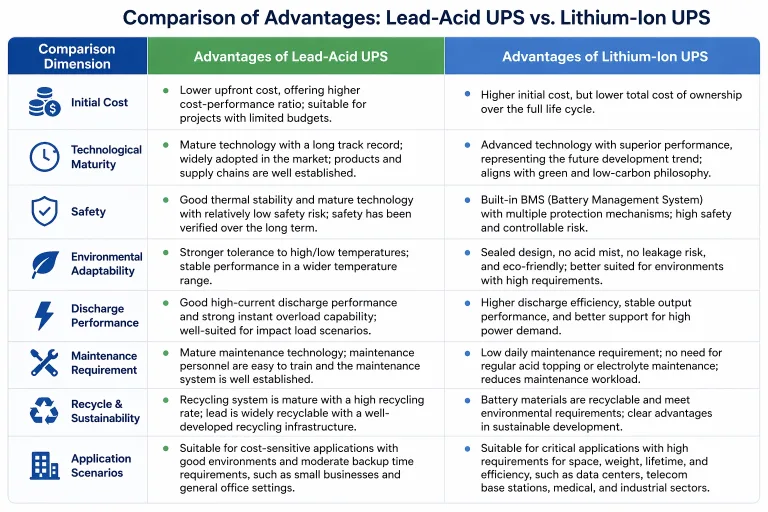
Lead acid UPS systems have a lower upfront cost, making them suitable for projects with limited budgets or short-term deployment plans.
Lithium battery UPS systems require higher initial investment due to advanced materials and integrated control systems.
Long-Term Cost Efficiency
Over the full lifecycle, lithium UPS systems typically deliver lower total cost of ownership (TCO) due to:
- Longer lifespan (fewer replacements)
- Reduced maintenance labor
- Lower cooling requirements
- Higher energy efficiency
For data centers operating continuously at scale, these savings often outweigh the higher initial investment.
Which Is Better for Data Centers?
When Lithium Battery UPS Is the Better Choice
Lithium battery UPS systems are ideal for:
- High-density data centers and AI workloads
- Edge data centers with limited space
- Facilities requiring long lifecycle and low maintenance
- Environments with unstable power supply
- Businesses focused on energy efficiency and sustainability
When Lead Acid UPS Still Makes Sense
Lead acid UPS systems may still be suitable for:
- Small-scale or legacy data centers
- Short-term projects with tight budgets
- Environments with stable power and low cycling frequency
Future Trends: Why Lithium UPS Is Gaining Market Share
The shift toward lithium battery UPS systems is driven by several macro trends:
- Increasing rack power density (AI and GPU clusters)
- Growth of edge computing and distributed infrastructure
- Rising energy efficiency and carbon reduction requirements
- Demand for reduced operational complexity
As data centers continue to scale and modernize, lithium UPS solutions are becoming the preferred standard for next-generation infrastructure.
Conclusion
The comparison between lithium battery UPS and lead acid UPS ultimately comes down to long-term strategy rather than short-term cost.
Lead acid remains a viable option for cost-sensitive or legacy deployments. However, for modern data centers prioritizing scalability, efficiency, and reliability, lithium battery UPS systems provide a more future-ready solution.
Organizations planning infrastructure upgrades or new deployments should evaluate not only initial investment but also lifecycle performance, operational risk, and total cost of ownership to make the most informed decision.
Looking to upgrade your data center power infrastructure?
Our modular UPS systems support lithium, lead acid, and next-generation battery technologies—helping you build a scalable, efficient, and future-ready power solution.
Contact our engineering team today for a customized UPS design tailored to your application.
FAQ
Is lithium battery UPS better than lead acid for data centers?
Yes, lithium battery UPS systems are generally better for modern data centers due to longer lifespan, higher efficiency, faster charging, and lower maintenance requirements.
Why are lithium UPS systems more expensive?
They use advanced battery chemistry and integrated management systems, which increase upfront cost but reduce long-term expenses.
How long do lithium UPS batteries last compared to lead acid?
Lithium batteries typically last 8–15 years, while lead acid batteries last around 3–5 years.