



Table of Contents
In the UPS industry, “high-frequency UPS” and “low-frequency UPS” (also known as transformer-based UPS) are often discussed as two fundamentally different technologies.
However, many buyers, integrators, and even some engineers misunderstand their real differences, leading to improper selection, overdesign, or unnecessary cost.
So what is the real difference between high-frequency UPS and low-frequency UPS, and how should you choose the right one for your application?
This article explains the differences from a practical engineering perspective rather than marketing claims.
Basic Technical Architecture
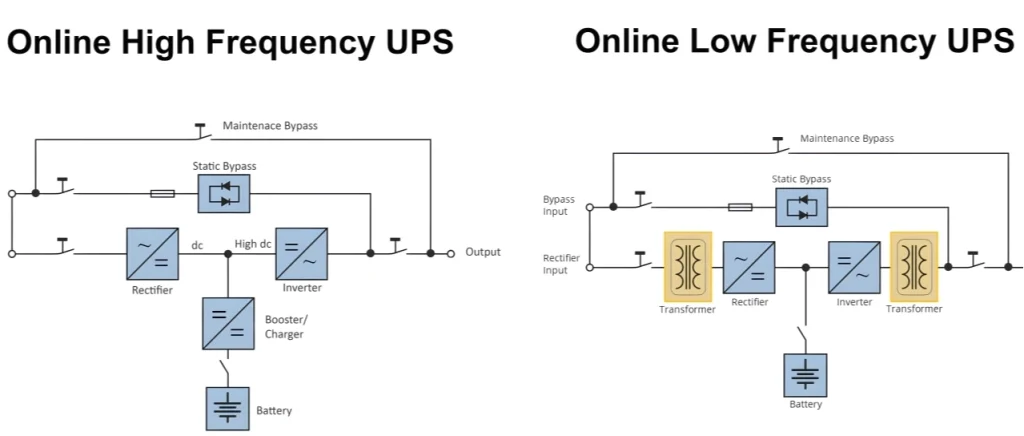
The core difference between high-frequency UPS and low-frequency UPS lies in their internal power conversion topology.
A low-frequency UPS uses a power-frequency transformer (50/60 Hz) at the output or inside the inverter stage. This transformer provides electrical isolation and voltage matching at line frequency.
A high-frequency UPS removes the large power-frequency transformer and instead uses high-frequency switching (typically tens of kHz) with IGBT or MOSFET devices, combined with high-frequency magnetic components.
In simple terms:
- Low-frequency UPS relies on “iron and copper”
- High-frequency UPS relies on “power electronics and control algorithms”
This architectural difference affects almost every other performance parameter.
Size, Weight, and Power Density
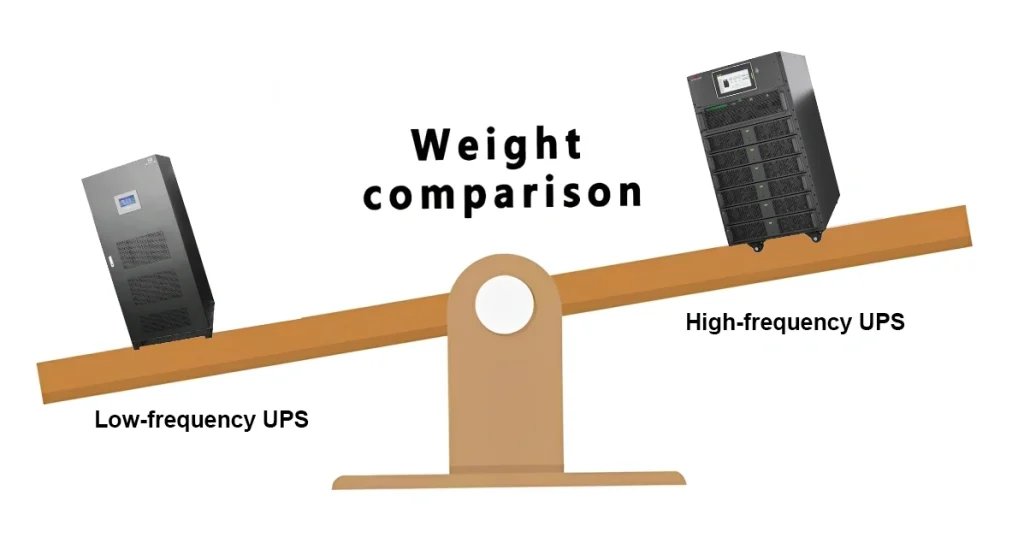
Low-frequency UPS systems are large and heavy because the 50/60 Hz transformer requires significant iron core volume and copper windings.
High-frequency UPS systems are much more compact and lightweight due to the elimination of the low-frequency transformer and the use of high-frequency conversion.
In real projects:
- High-frequency UPS is ideal for data centers, telecom rooms, and commercial buildings where space and floor load are limited
- Low-frequency UPS is often chosen for industrial environments where space is less critical
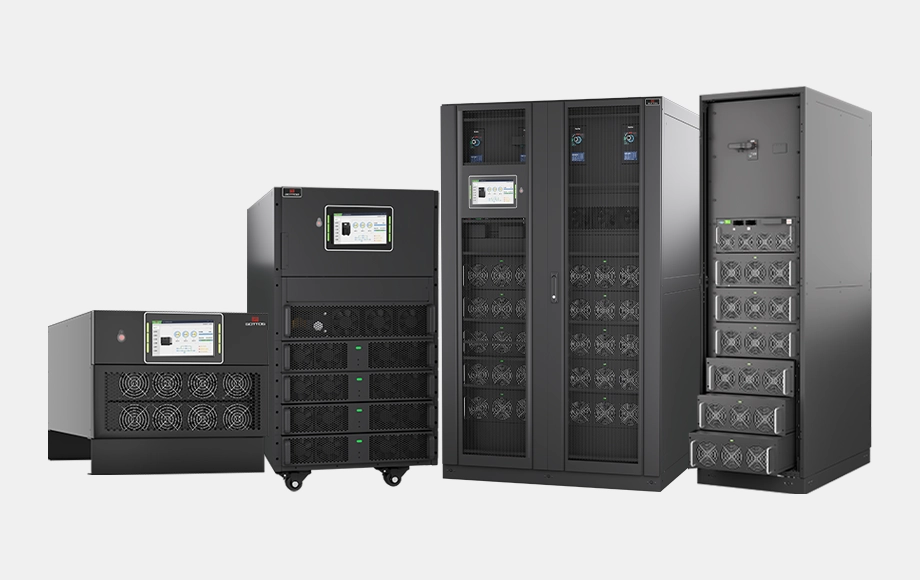
This is one of the main reasons why modern data centers increasingly prefer high-frequency and modular UPS solutions, such as those offered by Gottogpower.
Efficiency and Energy Consumption
High-frequency UPS systems generally achieve higher efficiency, especially under partial load conditions.
Typical characteristics:
- High-frequency UPS: higher efficiency, lower no-load loss, better performance at 30–60% load
- Low-frequency UPS: slightly lower efficiency due to transformer losses
In long-term operation, even a 1–2% efficiency difference can translate into significant electricity cost savings, especially for 24/7 data center environments.
For energy-conscious operators, high-frequency UPS offers a clear advantage.
Output Isolation and Load Compatibility
One traditional advantage of low-frequency UPS is its strong electrical isolation provided by the transformer.
This makes low-frequency UPS more tolerant of:
- Highly inductive loads
- High inrush current
- Harsh industrial electrical environments
- Certain non-linear or unbalanced loads
High-frequency UPS relies more on control algorithms and protection circuits rather than physical isolation. Modern designs are highly reliable, but they are still more sensitive to extremely harsh load conditions.
As a result:
- Low-frequency UPS is often used in heavy industry, oil & gas, mining, and rail systems
- High-frequency UPS dominates in IT, data centers, hospitals, and commercial applications
Reliability and Fault Handling
There is a common misconception that low-frequency UPS is always more reliable.
In reality:
- Low-frequency UPS has strong overload and short-circuit tolerance
- High-frequency UPS benefits from advanced digital control, fast response, and self-diagnostics
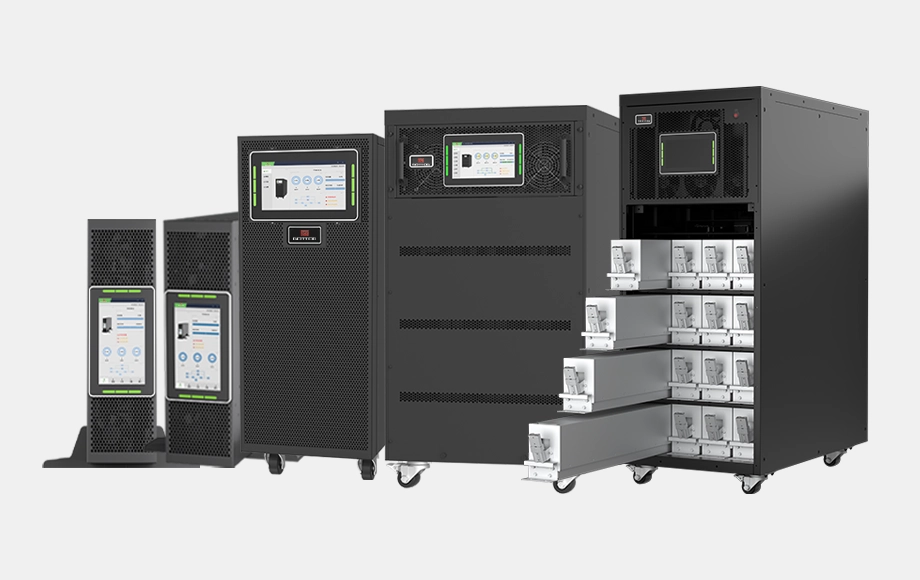
Modern high-frequency UPS platforms, especially modular UPS systems, improve system availability through redundancy and hot-swappable power modules.
From a system-level perspective, a modular high-frequency UPS can achieve higher overall availability than a traditional monolithic low-frequency UPS.
Maintenance and Total Cost of Ownership (TCO)
Low-frequency UPS systems:
- Have longer component life for transformers
- Are robust but costly to transport, install, and maintain
- Usually require heavier infrastructure
High-frequency UPS systems:
- Are easier to install and expand
- Reduce logistics and construction cost
- Support modular growth and faster maintenance
For data centers and commercial users, total cost of ownership often favors high-frequency UPS over the full lifecycle.
Application Scenarios: Which One Should You Choose?
There is no “better” UPS type in absolute terms—only a more suitable one.
Choose a high-frequency UPS if:
- You operate a data center or IT facility
- Space and efficiency are critical
- You plan for future scalability
- You prefer modular UPS architecture
Choose a low-frequency UPS if:
- You serve heavy industrial loads
- The environment is electrically harsh
- Isolation and overload capability are top priorities
Gottogpower focuses on high-frequency and modular UPS solutions designed for modern data centers, intelligent computing centers, and mission-critical IT infrastructure, where efficiency, scalability, and availability are key requirements.
Conclusion
The real difference between high-frequency UPS and low-frequency UPS is not just technology—it is philosophy.
Low-frequency UPS emphasizes physical robustness and isolation.
High-frequency UPS emphasizes efficiency, intelligence, and scalability.
Understanding these differences helps system designers and end users make informed decisions, reduce long-term cost, and build power systems that truly match their application needs.