



In modern data centers, availability is no longer a design objective—it is a contractual requirement. As workloads become more latency-sensitive and business systems move toward true 24/7 operation, even brief power interruptions can result in financial loss, SLA violations, and reputational damage. Within this environment, hot-swappable power modules have become a defining technology in modular UPS systems, directly influencing how availability is achieved and maintained.
Availability Challenges in Traditional UPS Architectures
Conventional monolithic UPS systems were designed for a different era, one in which maintenance windows were acceptable and load growth was relatively predictable. In practice, however, these systems introduce structural limitations that directly constrain availability.
When a critical power component fails or requires preventive maintenance, traditional UPS architectures often require system-level intervention. This may involve transferring loads to maintenance bypass, shutting down sections of the UPS, or coordinating complex procedures across power, facilities, and IT teams.
These interventions create three persistent risks. Planned downtime conflicts with always-on service expectations. Live maintenance increases exposure to human error. Recovery time following a fault is typically measured in hours rather than minutes. As data centers scale and power density increases, these risks become increasingly unacceptable.

What Hot-Swappable Power Modules Actually Change
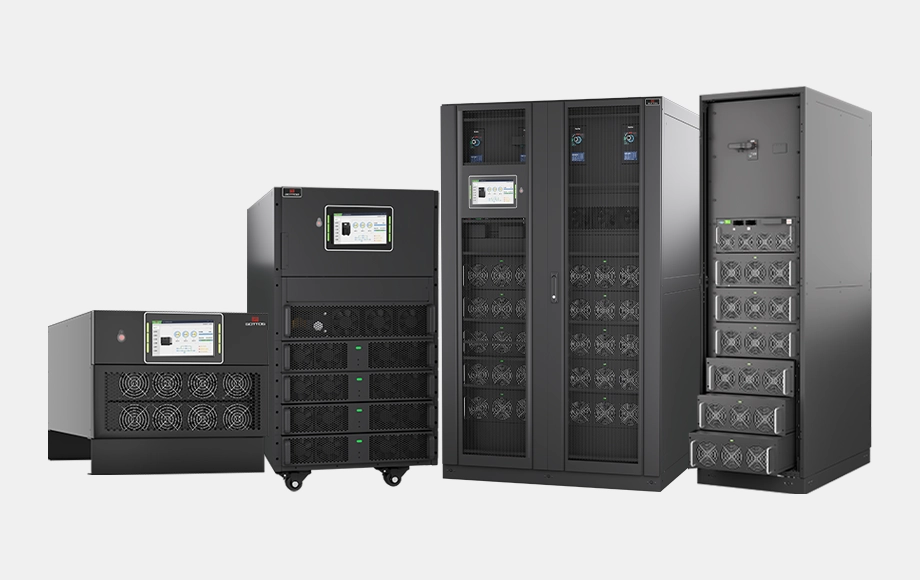
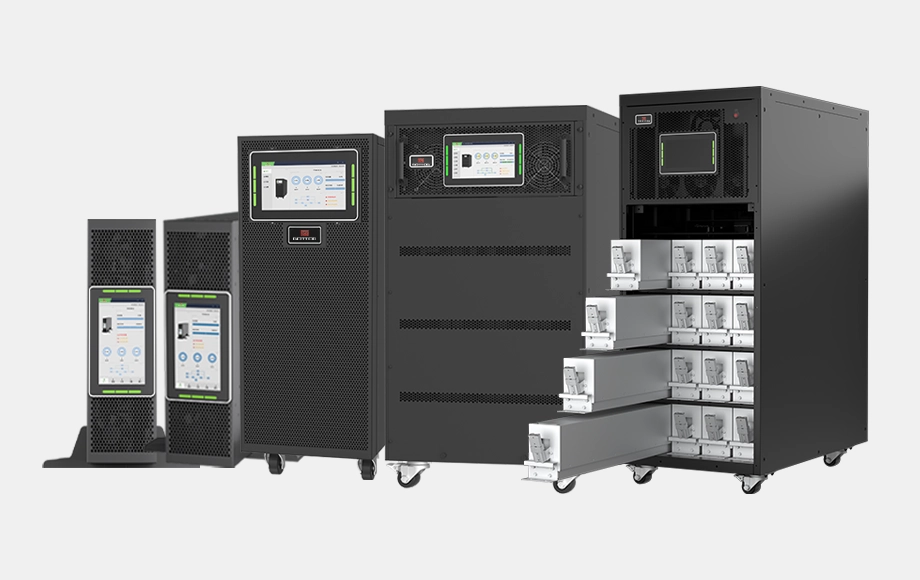
Hot-swappable power modules represent a fundamental shift in UPS design philosophy. In a Onduleur modulaire architecture, each power module is a self-contained unit with standardized electrical interfaces, control logic, and protection mechanisms. Modules operate in parallel and share load dynamically, allowing the system to tolerate the loss or removal of an individual unit without interrupting output power.
From a system perspective, this design transforms maintenance and fault handling from a system-wide event into a localized, module-level operation. From an operational perspective, it decouples availability from individual component failures.
Instead of stopping or bypassing the UPS to address an internal issue, operators can remove and replace a single module while the system remains online and fully protecting critical loads.
To better illustrate the design approach behind modular UPS power modules, the following video introduces the key technical features of our power module used in data center environments.
With this module-level design in mind, the impact on data center availability becomes much more concrete.
Direct Impact on Data Center Availability
The most immediate availability benefit of hot-swappable power modules is the dramatic reduction in Mean Time to Repair (MTTR). When a faulty module can be replaced in minutes rather than hours, the overall availability of the power system increases substantially.
In N+1 or N+X modular configurations, the failure of a single power module does not degrade power protection. Remaining modules automatically compensate for the lost capacity, maintaining stable output to the load. The failed module can then be replaced without transferring the system to bypass or exposing critical equipment to raw utility power.
This approach converts failure response from an emergency operation into a routine maintenance task, significantly improving real-world uptime.
Eliminating Maintenance-Induced Downtime
Industry data consistently shows that a large proportion of data center outages are caused not by hardware failures, but by maintenance activities. Hot-swappable power modules directly address this issue.
Because modules can be replaced under load, routine maintenance no longer requires shutdowns, bypass operations, or complex coordination across teams. Maintenance procedures become standardized, repeatable, and low risk.
As a result, data centers reduce both the frequency and severity of maintenance-induced incidents, improving availability without increasing operational complexity.
Enabling Scalability Without Availability Trade-Offs
Modern data centers rarely deploy their full power capacity on day one. Instead, capacity is added incrementally as workloads grow, racks are added, or power density increases—particularly in AI and high-performance computing environments.
Hot-swappable power modules allow capacity expansion while the UPS remains online. Additional modules can be installed without disrupting existing loads, ensuring that scalability does not come at the expense of availability.
This capability is especially valuable in modular and micro data center designs, where rapid deployment and phased expansion are core operational requirements.
Reducing Human Error Through Modular Design
Human error remains one of the leading causes of power incidents in mission-critical environments. Hot-swappable power modules help mitigate this risk by simplifying maintenance procedures.
Module replacement typically follows a guided, tool-less or semi-tool-less process with predefined mechanical and electrical interfaces. This reduces the likelihood of incorrect wiring, improper torque, or configuration mistakes. Lower dependence on highly specialized personnel further improves operational resilience.
By reducing both the frequency and complexity of manual interventions, modular UPS systems with hot-swappable modules achieve higher effective availability in real operating conditions.
Availability as a Strategic Design Outcome
Hot-swappable power modules are not merely a convenience feature; they are a strategic design choice aligned with the realities of modern data center operations. By reducing MTTR, eliminating maintenance-related downtime, enabling non-disruptive scalability, and minimizing human error, they transform availability from a theoretical metric into a practical, measurable outcome.
For data centers pursuing high uptime, predictable growth, and resilient operations, hot-swappable power modules are no longer optional. They are a foundational element of next-generation power infrastructure. Connect with J'ai le pouvoir to discuss modular UPS solutions designed for high-availability data center environments.